
by Paci | Oct 26
There is something truly special about descending beneath the ocean’s surface and entering a world that few people ever get to experience. The sunlight gradually fades, the reef changes character, and the sounds of the surface world disappear. For many scuba divers, going deeper is the next step in their underwater adventure. But is deep diving really worth it?
The answer depends on what you’re hoping to discover, your experience level, and how comfortable you are underwater. Deep diving can offer incredible encounters, dramatic underwater landscapes, and a sense of exploration that is difficult to replicate in shallow water. However, it also comes with additional risks, limitations, and responsibilities.
Let’s take a closer look at what makes deep diving so appealing, what you might encounter, and whether going deeper really makes for a better dive…
What Exactly Is Deep Diving?
In recreational scuba diving, a dive deeper than 18 meters (60 feet) is often considered a deep dive in training contexts. The commonly accepted maximum depth for recreational scuba diving is 40 meters (130 feet), although the limits of your certification, training, equipment, and dive conditions may require you to stay considerably shallower.
As you descend, the underwater environment changes. Water pressure increases, colours disappear at different depths, and your breathing gas supply is consumed more quickly. Nitrogen absorption also increases, which can contribute to nitrogen narcosis and decompression sickness risks.
Deep diving is therefore about much more than simply swimming further down. It requires careful planning, appropriate training, good buoyancy control, and a clear understanding of the risks involved.
The Call of the Deep: What Lies Below?
Why do divers want to go deeper when so much marine life thrives in shallow water?
One of the biggest attractions of deep diving is the opportunity to explore unique landscapes, encounter large marine creatures and discover history found only at depth.
Historic Shipwrecks
Many of the world’s most famous wrecks, such as wartime cargo ships, aircraft, and sunken naval vessels, rest on deep ocean floors out of the reach of novice divers. These submerged museums act as artificial reefs encrusted in coral while preserving human history.
Topographical Wonders
Deep drop-offs, dramatic underwater cliffs, walls, and blue holes offer breathtaking geological formations that provide a profound sense of scale and wonder.
Pelagic Encounters
Some deeper dive sites are known for encounters with larger pelagic animals, including sharks, rays, and in the waters around Nusa Lembongan, ocean sunfish or molas. Certain marine life, such as sunfish, or molas, can be found in deep, cooler water.
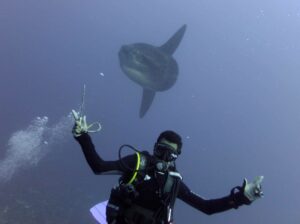
Deep diving with mola
There is also a personal challenge involved. Managing buoyancy, monitoring depth and air supply, and staying aware of your surroundings all demand concentration.
When performed within the limits of your training, deep diving can be a satisfying way to develop your skills and confidence underwater.
What Are the Downsides of Going Deep?
Despite its appeal, deep diving is not automatically better than diving shallower.
Your Bottom Time Becomes Shorter – As depth increases, the amount of time you can generally spend underwater without mandatory decompression becomes shorter. You also consume breathing gas more quickly because the surrounding pressure increases. This means a deep dive may offer less time to explore a particular site than a shallower dive. If you enjoy slowly searching a reef for small creatures, photographing coral, or watching fish behaviour, staying shallower may give you more time to enjoy the experience.
Gas Narcosis Can Affect Your Judgement – At depth, the increased partial pressure of nitrogen can cause nitrogen narcosis. Its effects vary between individuals and dives, but may include impaired judgement, reduced concentration, slower reactions, and a sense of unusual confidence or confusion. These effects can be particularly concerning because a diver may not immediately recognise that their judgement has been affected. This is one reason why deep diving requires appropriate training, careful depth management, and a willingness to end the dive or ascend if something does not feel right.
There Are Greater Safety Considerations – Deep diving increases several important risks, including gas-management problems, narcosis, and decompression sickness. Emergencies can also be more challenging to manage at greater depths. Divers should never exceed their certification or training limits simply to reach a particular depth. A dive plan should include appropriate gas reserves, depth and time limits, suitable equipment, a reliable buddy, and a clear ascent plan. Divers should also understand that decompression stops and safety stops serve different purposes. A safety stop is commonly recommended on recreational dives, while required decompression stops are mandatory obligations that must be followed according to the dive plan and training.
Is Deep Diving Worth It for Underwater Photography?
For underwater photographers, the answer depends on the subject.
Deeper sites can provide historical insights of sunken wrecks, unusual marine life, and striking wall formations. However, there is often less natural light, which can make photography more challenging. Colours such as red and orange are progressively absorbed by water, leaving underwater scenes increasingly blue or green.
Flash or video lights can help restore colour to nearby subjects, but lighting and positioning become more demanding as conditions change.
For many photographers, the best images actually come from shallower dives. Clear water, better natural light, colourful coral, and more time to compose a shot can produce outstanding results without the additional demands of deep diving.
If photography is your priority, consider the subject you want to capture before deciding on the depth.
How Deep Should You Go?
There is no single ideal depth for every diver.
Beginners should concentrate on mastering buoyancy, trim, air consumption, and communication within the limits of their certification. These fundamentals make every future dive more enjoyable and safer.
It is also worth remembering that deeper is not necessarily more adventurous. A shallow drift dive over a thriving reef, such as those found around Nusa Penida, can be every bit as memorable as a dive at 30 metres. Indeed, the manta rays found on the south coast of Nusa Penida are mostly seen between 5 and 15 meters.
The best depth is the one that allows you to enjoy the site comfortably while remaining within your training and planned limits.
More experienced divers who want to explore deeper sites should consider a recognised deep-diving course, dive with an appropriately qualified professional, and choose conditions suited to their experience.
Already an Advanced Diver? The PADI Deep Diver Specialty consists of 4 dives and provides additional training to allow a diver to dive to a maximum of 40 meters:
So, Is It Worth Going Deep?
Deep diving can absolutely be worth it. It opens the door to different underwater landscapes, specialised dive sites, and experiences that may not be available closer to the surface.
Most of our mola sightings are in the 30 meter range, so an Advanced level diver has a better chance of seeing one of these magnificent creatures.
For more information on molas, check out the PADI Mola Mola Awareness course, exclusive to Tamarind Divers:
But depth alone does not make a dive extraordinary. The quality of the marine life, visibility, currents, dive conditions, and your own interests all play an important role.
If you love exploring wrecks or dramatic underwater terrain, and are prepared to develop the skills needed to dive deeper responsibly, it may be a rewarding next step. If you prefer colourful reefs, longer bottom times, and relaxed encounters with marine life, shallower dives may offer more of what you enjoy.
Ultimately, the goal is not to see how deep you can go. It is to discover how much the underwater world has to offer at a depth that suits you.
Because when it comes to scuba diving, the most memorable dive is rarely the one with the biggest number on the depth gauge. It is the one that leaves you wanting to get back in the water again.